
Tracking MLB Playoffs
This integration scenario explains how to track and render the MLB postseason using the Sportradar MLB API. It covers how to identify playoff teams, discover postseason series and games, monitor series progression, retrieve game and series statistics, and support live and postgame playoff experiences.
This scenario is commonly used to:
- Build postseason brackets and series pages
- Track playoff qualification and seeding context
- Render series schedules, statuses, and results
- Support live playoff game centers
- Display cumulative series statistics for teams and players
This scenario focuses on the postseason tracking workflow across standings, schedules, series, games, and series-level stats. Regular season standings, live game tracking, and broader statistics workflows are covered separately in their respective integration scenarios.
Overview
Tracking the MLB postseason requires combining multiple feeds because playoff coverage spans several layers:
- Standings / Rankings identify which teams have clinched and their postseason positioning
- Series Schedule provides the postseason bracket structure, participants, and games for each series
- Game feeds power live and postgame playoff game experiences
- Series Summary and Series Statistics provide team and player performance across a playoff series
From an integration perspective, applications typically:
- Monitor standings late in the regular season for clinch and seeding context
- Switch to postseason schedule and series tracking once matchups are known
- Retrieve
series.id,game.id, and participatingteam.idvalues - Power live playoff coverage with game feeds
- Update bracket, series record, and cumulative series stats as games move to
closed
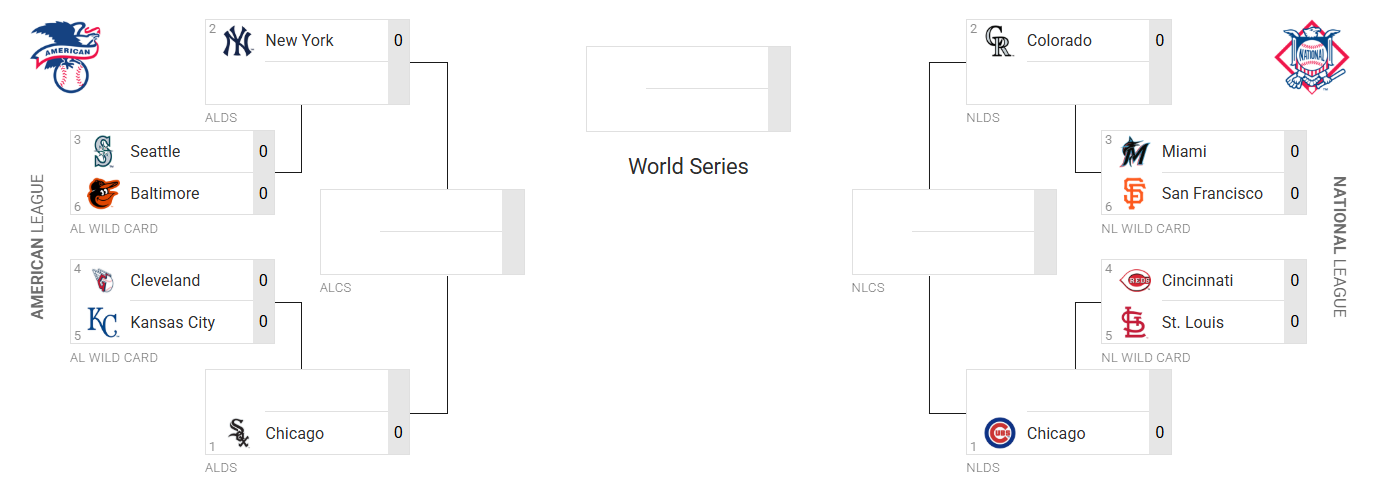
The following example illustrates how postseason series are structured across rounds, which can be constructed using data from the Series Schedule feed.
Relevant Feeds
The following feeds are commonly used to track MLB playoff qualification, series progression, and postseason performance.
| Feed | Purpose |
|---|---|
| Standings | Track playoff qualification, games back, and clinch context late in the year |
| Rankings | Retrieve streamlined rank and clinch status |
| Series Schedule | Retrieve postseason series, participants, games, and bracket structure |
| Game Summary | Retrieve live and postgame playoff game data |
| Game Extended Summary | Retrieve expanded live and postgame playoff game detail |
| Game Boxscore | Retrieve inning-by-inning scoring and final game totals |
| Game Play-by-Play | Retrieve pitch-by-pitch and event-level playoff game updates |
| Series Summary | Retrieve team and player statistics for an entire postseason series |
| Series Statistics | Retrieve detailed statistics for a postseason series and participating team |
| Daily Change Log | Detect updated schedules, games, and standings |
High-Level Workflow
A typical playoff tracking integration follows this flow:
Standings / Rankings → Series Schedule → Series ID + Game ID → Live / Postgame Game Feeds → Series Stats
- Monitor standings and rankings for clinched teams and postseason positioning
- Retrieve postseason series and game structure from Series Schedule
- Capture
series.id,game.id, and participatingteam.idvalues - Track each playoff game live or postgame with game feeds
- Update series-level status, records, and cumulative statistics as games conclude
Integration Steps
Although there are multiple ways to track the postseason, the following steps represent a common and recommended flow.
1. Start with Postseason Qualification Context
Before the bracket is fully formed, use Standings and optionally Rankings to monitor:
- Division leaders
- Wildcard positioning
- Clinch status
- Elimination status
This is especially useful late in the regular season when your application needs to show which teams are in playoff position or have officially clinched. For details on retrieving standings and rankings, see the Retrieving Standings and Rankings integration scenario.
Standings vs. RankingsStandings are best when you need full competitive context such as records, games back, streaks, and elimination numbers.
Rankings are best when you only need placement and clinch status in a lighter-weight response.
2. Build the Postseason Bracket with Series Schedule
Once postseason tracking begins, call Series Schedule using the postseason season type:
GET /mlb/{access_level}/v8/{language_code}/series/{season_year}/PST/schedule.{format}This feed provides:
- Postseason series metadata
series.id- Series round information such as
ALWC1,NLDS2,ALCS,NLCS, orWS. Wild Card (ALWC,NLWC) and Division Series (ALDS,NLDS) values carry a trailing1or2identifying the bracket slot within that round; Championship Series (ALCS,NLCS) and World Series (WS) values do not. - Participant teams and series records
- All games associated with each series
- Each game's
game.id,scheduledtime, venue, and status
<league xmlns="http://feed.elasticstats.com/schema/baseball/v8/series.xsd" alias="MLB" name="Major League Baseball" id="2fa448bc-fc17-4d3d-be03-e60e080fdc26">
  <season-schedule id="66255330-1e36-4898-83cc-a175c256b9fb" year="2026" type="PST">
    <!-- Wild Card: Astros (seed 3) vs White Sox (seed 6); White Sox advance 2-1 -->
    <series title="AL Wildcard - CWS vs HOU" start_date="2026-09-29" id="54cc0a62-577e-46f6-9c04-923bbd9ffa03" round="ALWC1" best_of="3" status="closed">
      <participant name="White Sox" record="2">
        <team name="White Sox" market="Chicago" abbr="CWS" id="47f490cd-2f58-4ef7-9dfd-2ad6ba6c1ae8" seed="6"/>
      </participant>
      <participant name="Astros" record="1">
        <team name="Astros" market="Houston" abbr="HOU" id="eb21dadd-8f10-4095-8bf3-dfb3b779f107" seed="3"/>
      </participant>
      <games>
        <game id="abfe1ab0-7f1e-4e80-8c80-54565063a75a" status="closed" scheduled="2026-09-29T21:00:00+00:00" ps_round="ALWC" ps_game="1" home_team="eb21dadd-8f10-4095-8bf3-dfb3b779f107" away_team="47f490cd-2f58-4ef7-9dfd-2ad6ba6c1ae8">
          <!-- venue, home, away, broadcasts omitted for brevity -->
        </game>
        <game id="5a8daeb0-78c5-4553-be7f-35fcd14dc021" status="unnecessary" scheduled="2026-10-01T21:00:00+00:00" ps_round="ALWC" ps_game="3" home_team="eb21dadd-8f10-4095-8bf3-dfb3b779f107" away_team="47f490cd-2f58-4ef7-9dfd-2ad6ba6c1ae8">
          <!-- venue, home, away, broadcasts omitted for brevity -->
        </game>
      </games>
    </series>
    <!-- Division Series: Guardians (seed 2) host the 3/6 WC winner; Guardians advance 3-2 -->
    <series title="ALDS - CWS vs CLE" start_date="2026-10-03" id="fc7067af-d8c7-47f5-b68d-0be0c78457af" round="ALDS2" best_of="5" status="closed">
      <participant name="Guardians" record="3">
        <team name="Guardians" market="Cleveland" abbr="CLE" id="80715d0d-0d2a-450f-a970-1b9a3b18c7e7" seed="2"/>
      </participant>
      <participant name="White Sox" record="2">
        <team name="White Sox" market="Chicago" abbr="CWS" id="47f490cd-2f58-4ef7-9dfd-2ad6ba6c1ae8" seed="6"/>
      </participant>
      <games>
        <game id="083aac47-dd0a-44f2-b8b6-0705fb97beb6" status="closed" scheduled="2026-10-03T17:00:00+00:00" ps_round="ALDS" ps_game="1" home_team="80715d0d-0d2a-450f-a970-1b9a3b18c7e7" away_team="47f490cd-2f58-4ef7-9dfd-2ad6ba6c1ae8">
          <!-- venue, home, away, broadcasts omitted for brevity -->
        </game>
        <game id="c578c55b-67d1-466b-8e4a-aeb899fca38f" status="closed" scheduled="2026-10-11T00:00:00+00:00" ps_round="ALDS" ps_game="5" home_team="80715d0d-0d2a-450f-a970-1b9a3b18c7e7" away_team="47f490cd-2f58-4ef7-9dfd-2ad6ba6c1ae8">
          <!-- venue, home, away, broadcasts omitted for brevity -->
        </game>
      </games>
    </series>
  </season-schedule>
</league>
{
"league": {
"alias": "MLB",
"name": "Major League Baseball",
"id": "2fa448bc-fc17-4d3d-be03-e60e080fdc26"
},
"season": {
"id": "66255330-1e36-4898-83cc-a175c256b9fb",
"year": 2026,
"type": "PST"
},
"series": [
{
"title": "AL Wildcard - CWS vs HOU",
"start_date": "2026-09-29",
"id": "54cc0a62-577e-46f6-9c04-923bbd9ffa03",
"round": "ALWC1",
"best_of": 3,
"status": "closed",
"participants": [
{ "name": "White Sox", "record": 2, "team": { "name": "White Sox", "market": "Chicago", "abbr": "CWS", "id": "47f490cd-2f58-4ef7-9dfd-2ad6ba6c1ae8", "seed": 6 } },
{ "name": "Astros", "record": 1, "team": { "name": "Astros", "market": "Houston", "abbr": "HOU", "id": "eb21dadd-8f10-4095-8bf3-dfb3b779f107", "seed": 3 } }
],
"games": [
{ "id": "abfe1ab0-7f1e-4e80-8c80-54565063a75a", "status": "closed", "scheduled": "2026-09-29T21:00:00+00:00", "ps_round": "ALWC", "ps_game": "1" },
{ "id": "5a8daeb0-78c5-4553-be7f-35fcd14dc021", "status": "unnecessary", "scheduled": "2026-10-01T21:00:00+00:00", "ps_round": "ALWC", "ps_game": "3" }
]
},
{
"title": "ALDS - CWS vs CLE",
"start_date": "2026-10-03",
"id": "fc7067af-d8c7-47f5-b68d-0be0c78457af",
"round": "ALDS2",
"best_of": 5,
"status": "closed",
"participants": [
{ "name": "Guardians", "record": 3, "team": { "name": "Guardians", "market": "Cleveland", "abbr": "CLE", "id": "80715d0d-0d2a-450f-a970-1b9a3b18c7e7", "seed": 2 } },
{ "name": "White Sox", "record": 2, "team": { "name": "White Sox", "market": "Chicago", "abbr": "CWS", "id": "47f490cd-2f58-4ef7-9dfd-2ad6ba6c1ae8", "seed": 6 } }
],
"games": [
{ "id": "083aac47-dd0a-44f2-b8b6-0705fb97beb6", "status": "closed", "scheduled": "2026-10-03T17:00:00+00:00", "ps_round": "ALDS", "ps_game": "1" },
{ "id": "c578c55b-67d1-466b-8e4a-aeb899fca38f", "status": "closed", "scheduled": "2026-10-11T00:00:00+00:00", "ps_round": "ALDS", "ps_game": "5" }
]
}
]
}This feed becomes the backbone for postseason bracket pages and series navigation.
Linking Series into a Bracket
The MLB Series Schedule does not currently expose an explicit source or feeder-series reference, so bracket progression must be reconstructed from round and participant seed.
Under the current MLB postseason format, the bracket is fixed by seed:
- Wild Card:
ALWCandNLWCmatch seed 3 vs seed 6 and seed 4 vs seed 5 (best-of-3). - Division Series: in each league, the seed-1 team's series hosts the 4/5 Wild Card winner; the seed-2 team's series hosts the 3/6 Wild Card winner (best-of-5).
- League Championship Series: the two AL Division Series winners meet in the
ALCS; the two NL Division Series winners meet in theNLCS(best-of-7). - World Series: the
ALCSwinner meets theNLCSwinner (best-of-7).
A typical reconstruction pass looks like this:
- Group series by league and by round:
ALWC→ALDS→ALCSandNLWC→NLDS→NLCS, then both leagues converging onWS. - Use the seed rules above to map each Wild Card winner to its Division Series, each Division Series winner to the LCS, and each LCS winner to the World Series.
- Before a matchup is finalized, use the placeholder participants (for example
Higher WC Winner,Wildcard #1) to render the slot while it is still TBD. Their team IDs are stable across seasons, so they can be mapped once from the Teams endpoint. - After games close, refresh Series Schedule and re-derive the participants of the next round from any series that have clinched.
This mapping is tied to the current MLB postseason format. If MLB changes the number of teams, seeds, or host rules, the linkage logic above must be updated.
Postseason Placeholder Teams (TBD vs Named Slots)In MLB postseason data, placeholder participants may not appear as
TBD.Instead, you may see labels such as:
Wildcard #1Division #1Higher WC WinnerThese represent seed-based or bracket-based placeholders and serve the same purpose as
TBDin other sports.As postseason matchups become finalized, these placeholders are replaced with actual team data.
Your application should treat these values as temporary participants and update them as the bracket is confirmed.
Use the Teams endpoint to retrieve the full list of placeholder team names and IDs. These placeholder IDs are consistent across seasons, so you can map them once and reuse them in future postseasons.
Postseason Data Timing Expectations
- Initial postseason schedule (TBD matchups) is typically available in August.
- Teams populate into series shortly after clinching, usually by the end of that day.
- Advancing teams update in feeds the night of advancement, following game completion.
These updates are processed quickly, but applications should account for short delays when rendering brackets or resolving placeholders.
3. Store the Core IDs You Will Reuse
As you process the Series Schedule response, capture and persist:
series.idfor series-level pages and series statisticsgame.idfor live and postgame game trackingteam.idfor linking standings, team pages, and team-specific series stats
These IDs allow you to connect postseason bracket data to game feeds and statistics feeds without re-deriving relationships later.
4. Track Playoff Games Live and Postgame
Once you have the game.id, use the standard live game endpoints to power playoff game experiences:
These feeds support:
- Live scoreboards
- Inning state and scoring progression
- Pitch-by-pitch timelines
- Final playoff game recaps
- Historical postseason game pages
For full live implementation guidance, see the Tracking Live Games integration scenario.
5. Update the Bracket and Series State as Games Close
As postseason games move to closed, refresh Series Schedule to reflect:
- Updated series records
- Completed games
- Newly scheduled or newly necessary games
- Series status changes
This is how your bracket, series pages, and round views stay synchronized with actual playoff progression.
Determining the series winner. Each participant carries a record attribute that counts games won in the series. A series is clinched when a participant's record reaches a majority of best_of (3 for a best-of-5, 4 for a best-of-7). Games with status="unnecessary" should be excluded from any count and hidden from a bracket view.
If your application monitors updates continuously, the Daily Change Log can help detect when schedules, standings, or games have changed before you refresh downstream feeds.
6. Add Cumulative Series Performance
To show how a team or players are performing across an entire playoff matchup, add series-level statistics.
Series Summary
GET /mlb/{access_level}/v8/{language_code}/series/{series_id}/summary.{format}Series Statistics
GET /mlb/{access_level}/v8/{language_code}/series/{series_id}/teams/{team_id}/statistics.{format}These feeds support:
- Team-level series hitting, pitching, and fielding totals
- Player-level cumulative series performance
- Starter and bullpen breakdowns
- Series recap pages
- “Through the series” comparison modules
Use Series Summary when you want a broader multi-team view of the series.
Use Series Statistics when you want detailed statistics for a specific participating team.
Series Stats TimingSeries-level statistics update after games move to
closed, so they are best suited for postgame refreshes, series recaps, and between-game updates rather than pitch-by-pitch live rendering.
7. Support TBD and Evolving Matchups
Early postseason schedule data may include TBD participants or partially known matchups, especially before all qualifying teams and seeds are finalized.
Your application should be prepared to handle:
- Placeholder series participants
- Future games that are present but not yet fully confirmed
- Series that become unnecessary depending on prior game outcomes
- Rescheduled or delayed postseason games
This is especially important for bracket views and schedule pages that are published before every matchup is finalized.
Note: Postseason series may still display seed-based placeholders (for example, Wildcard #1 or Higher WC Winner) until matchups are finalized. Postseason data, including team assignments and series advancement, typically updates the night of clinching or advancement.
Use the Teams endpoint to retrieve the full list of placeholder team names and IDs. These placeholder IDs are consistent across seasons.
Common Use Cases
- Postseason bracket pages
- Wildcard, Division Series, Championship Series, and World Series hubs
- Series tracker pages
- Live playoff game centers
- Series recap and comparison modules
- Team or player postseason performance panels
Best Practices
- Use Standings as the primary source for playoff race context before the bracket is finalized.
- Use Series Schedule as the core postseason structure feed once playoff matchups are available.
- Store and reuse
series.id,game.id, andteam.idacross your postseason workflow. - Use standard game feeds for live playoff coverage rather than relying on series feeds for real-time detail.
- Refresh Series Schedule after games close so bracket progression and series records remain accurate.
- Use Series Summary and Series Statistics for between-game and postgame series analysis.
- Be prepared for TBD participants, unnecessary games, and postseason schedule revisions.
- Use the Daily Change Log to reduce unnecessary polling and selectively refresh changed postseason resources.
Updated about 23 hours ago